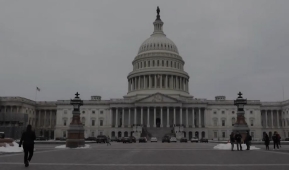
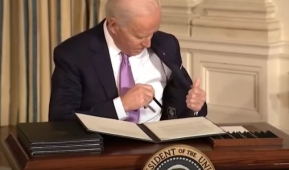
Chair of the Norwegian Nobel Committee, Thorbjorn Jagland, announces that President Barack Obama is the winner of the 2009 Nobel Peace Prize in Oslo on Friday, Oct 9, 2009. (AP Photo/Torbjorn Gronning)
(CNSNews.com) – A Norwegian committee’s decision to award the 2009 Nobel peace prize to President Obama continues to make waves around the world, with some of the focus shifting away from the appropriateness of the choice to the implications for future U.S. policy.
 
The Norwegian government has confirmed that Obama will travel to Oslo to receive the award at a ceremony on December 10. He is the first sitting U.S. president to win the award since Woodrow Wilson in 1919, the year he founded the League of Nations. Wilson had been president for six years.
 
Whether applauding or criticizing the 2009 decision, one theme evident in international reaction is the view that the award is an “advance” or “down payment” – an attempt to prod the United States further down the path that Obama is following.
 
Even before the surprise decision was announced Friday, a close observer of the process – without predicting that Obama would win – surmised that this was precisely what the five prize committee judges had in mind.
 
“They want the prize to have an impact on things that are about to happen and want to affect events,” Kristian Berg Harpviken, head of the International Peace Institute in Oslo, told Reuters.
 
Coming at a time when the administration is grappling with the issue of whether or not to deploy tens of thousands more troops in Afghanistan and with how to deal with Iran if the nuclear dispute is not resolved, the award is seen in some quarters as an attempt to influence those decisions.


(Photo courtesy of the Nobel Web site)
Gennady Zyuganov, leader of the Communist Party in Russia, called the Nobel move “a sort of warning to the U.S. president not to start a war against Iran.”
 
“In granting him the prize, the Norwegians are signaling to Obama that he should continue along his current path, that he should avoid an escalation in Afghanistan and a war against Iran,” asserted Israeli commentator Aluf Benn in Ha’aretz.
 
“It is from now on his duty to prove that he deserves it,” columnist Elias Harfoush wrote in Lebanon’s Dar al-Hayat newspaper.
 
Tariq Alhomayed, editor-in-chief of the pan-Arab daily Asharq Al-Awsat, recalled that as a child his grandfather would give him a small amount of money on the first day of exams; if he failed, he had to return it. Alhomayed wondered whether Obama would have to give the award back if he did not deliver.
 
Citing looming decisions on Afghanistan and Iran, Bronwen Maddox, foreign commentator for The Times of London, said Obama would “surely not (we must hope) be swayed in such deliberations” by having won the prize.
 
But she warned that giving the award to someone engaged in conflict resolution could have an impact.
 
Maddox recalled that after International Atomic Energy Agency (IAEA) chief Mohamed ElBaradei received the prize in 2005, “British and U.S. officials working to combat Iran’s nuclear ambitions, who had long accused him of being protective of Iran, felt that the Nobel award then reinforced him in his belief that he should resist Western pressure.”
 
At The Huffington Post, M.J. Rosenberg, senior foreign policy fellow at the left-wing Media Matters Action Network, wrote that before he was named as the peace prize winner, Obama was “not inclined” to launch an attack on Iran’s nuclear installations or to approve of an Israeli one.
 
“The early awarding of this prize will only strengthen him in that resolve. The ‘bomb Iran’ option is off the table.”
 
“The internationalists have tied Obama’s hands,” Prof. William Jacobson at the Cornell Law School commented on his blog. “This Peace Prize was given to Obama in order manipulate our policies and national security decisions. And I think it will work. At least until the next Presidential election.”
 
Meanwhile, the Norway Post said reactions to the Obama decision had poured in over the weekend, and that “for every positive reaction there are more than five negative ones.”
 
In the Czech Republic, an unscientific online poll by the Ceske noviny newspaper found 81 percent of more than 3,000 respondents said Obama did not deserve the prize, while only 19 percent said he did.
 
A number of former Nobel peace prize winners – including former Soviet President Mikhail Gorbachev, Israeli President Shimon Peres and South Africans Nelson Mandela and Desmond Tutu – applauded the choice of Obama.
 
One who did not was former Polish President Lech Walesa, who said it was “too soon,” adding that Obama had “not yet made a real input.” Walesa won the prize in 1983 for his leadership of the Solidarity labor movement that helped to topple communism.