Netanyahu, on Eve of U.S. Visit, Insists on Israel’s Right to Build in Jerusalem

March 22, 2010
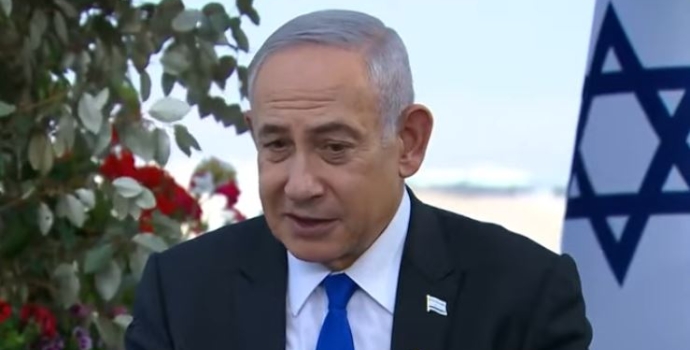
The Israeli prime minister told his cabinet Sunday that building in Jerusalem was nothing new, and would continue. He says Jerusalem is not a settlement.
Netanyahu

Israeli Prime Minister Binyamin Netanyahu, pictured here with visiting U.N. Secretary-General Ban Ki-moon in Jerusalem on Sunday, March 21, 2010, is due to meet with President Obama in Washington on Tuesday. (AP Photo/Jim Hollander, Pool)

(CNSNews.com) – Ahead of what may be a prickly meeting with President Obama, Israeli Prime Minister Binyamin Netanyahu signaled Sunday that the recent diplomatic dispute with the U.S. has not changed his government’s stand on Israel’s right to build freely in Jerusalem.
 
The government has, however, agreed to set in place a “mechanism” aimed at preventing further “surprises” between the longstanding allies, following the flare-up over an announcement, during a visit by Vice President Joe Biden, of a new housing project in the city.
 
It has also offered several other concessions, agreeing to ease the security blockade of the Gaza Strip and conceding that planned U.S.-mediated “proximity” talks with the Palestinian Authority (P.A.) will be able to discuss – although not reach final agreement on – core issues in the conflict. Israel had initially wanted the indirect talks to be limited to laying the groundwork for getting direct negotiations resumed.
 
The declaration by a planning agency that 1,600 new homes would be built in the capital brought strong and sustained criticism by the administration and pressure on Netanyahu to go beyond apologizing for the timing of the announcement and to rescind the decision.
 
But Netanyahu told his cabinet Sunday that building in Jerusalem was nothing new, and would continue.
 
“Our policy toward Jerusalem is the same policy of all Israeli governments in the past 42 years and it has not changed,” he said, referring to the time period since Israel captured the disputed West Bank from the Jordanians in 1967 and reunited the city which had been divided for the previous 19 years.
 
The international community does not recognize Israel’s sovereignty over Jerusalem, but Netanyahu stressed that treating the city like any other part of Israel is a non-negotiable.
 
“From our point of view, construction in Jerusalem is like construction in Tel Aviv,” he told cabinet ministers. “These are the things which we have made very clear to the American administration.”
 
Netanyahu said that to ensure that matters “not be left subject to commentary and speculation,” he had written a letter to Secretary of State Hillary Clinton making clear the positions on Jerusalem, and on the proximity talks.
 
In those talks, he said, “each side will be able to raise its positions on the issues in dispute.”
 
But solutions to the problems and a final peace agreement would have to come in subsequent direct talks between Israel and the P.A.
 
Proximity talks are a diplomatic device in which a mediator shuttles between parties which are geographically close by but are not yet ready to sit down across a table from each other. Netanyahu has been calling for direct talks since coming to office almost a year ago, but P.A. chairman Mahmoud Abbas demurred, citing construction in Israeli settlements on disputed land.
 
Last October, Netanyahu agreed under U.S. pressure to a 10-month freeze in settlement activity, but said it did not apply to Jerusalem, which is “not a settlement.”
 
Israel painted the freeze agreement as a concession designed to help restart talks; Netanyahu stressed – and Clinton agreed during a joint press conference in Jerusalem at the end of that month – that since the launching of the Oslo process in 1993, an Israeli settlement freeze had never been a precondition for a resumption of talks.
 
Netanyahu will be in Washington Monday to address the annual American Israel Public Affairs Committee (AIPAC) conference, and his office says he has been invited to meet with Obama at the White House on Tuesday.
 
The administration’s decision to get tough with Israel over the housing announcement prompted considerable commentary about the state of bilateral relations, and a number of U.S. lawmakers voiced concern.
 
Although Netanyahu came under fire from some on the Israeli left for the dispute with Obama, leading figures in his Likud Party urged him Sunday to hold the line when he reaches Washington.
 
Silvan Shalom, a Likud minister who also serves as vice prime-minister, told a party conference in Tel Aviv that Netanyahu was taking with him to the U.S. “a mandate from the entire Jewish nation to protect Jerusalem for all eternity.”
 
Likud lawmaker Reuven Rivlin, speaker of the Knesset, said at the same event that “whoever questions Jerusalem, questions Israel’s existence.”
 
Shalom and Rivlin both called for the U.S. to move its embassy from Tel Aviv to Jerusalem. U.S. law in 1995 called for the embassy to be relocated by 1999, but a built-in waiver has been exercised by Presidents Clinton, Bush and Obama ever since.
 
Netanyahu is expected also to meet with Clinton on Monday, when the Secretary of State is also due to address the AIPAC gathering.
E-Brief